Buying Your First Business: The Complete Beginner's Guide


Value the Business
Most small businesses are valued using the market approach comparing them to similar recent sales (comps).
Typical valuation method: Seller’s Discretionary Earnings (SDE) × industry multiple.
Average national multiples:
- All businesses: 2.5× cash flow / 0.7× revenue
- Online & Technology: highest at 3.5 cash flow
- Food & Restaurants: lower at 2× cash flow
Important adjustments:
- Add-backs: Owner salary, personal expenses, and other tax-minimizing deductions must be added back to show true cash flow available to a new owner.
- Qualitative factors: Growth trends, customer concentration, recurring revenue, and how dependent the business is on the current owner all affect the multiple.
Explore your options
Before searching, define clear criteria so you don’t waste time on poor fits.
- Assess your skills and preferred involvement: active management or passive investment?
- Set practical limits: maximum purchase price, preferred location, and industries.
- Match the business to your expertise and lifestyle goals.
Key insight: Entrepreneurship through acquisition (“buy then build”) lets you start with an already running business.
Find an opportunity that fits
Use multiple channels and stay organized:
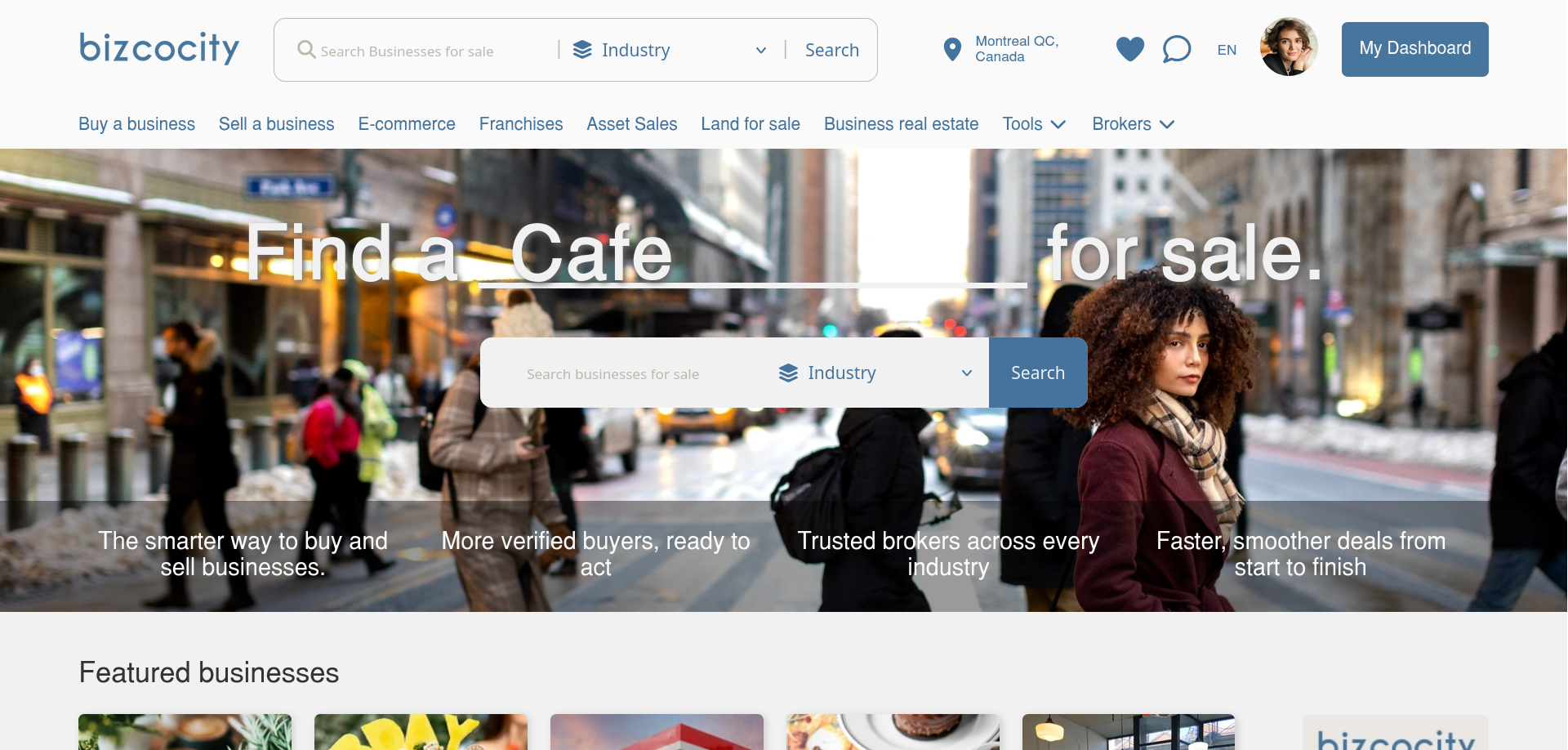
- Online marketplaces: filter by industry, location, and price among other metrics.
- BrokerGenius: (link to site)Bizcocity’s proprietary algorithm which tailors search results, making it easier then ever to find an opportunity that suits your needs.
- Business brokers: access to vetted and sometimes off-market deals.
- Your professional network: industry contacts, advisors, even competitors.
Track every conversation and keep detailed notes on each opportunity.

Negotiating the price
Price is only one part of the deal terms matter just as much.
- Letter of Intent (LOI): Formal document outlining price, key terms, contingencies (financial review, equipment condition), and earnest money deposit.
- Key terms to negotiate: training period, non-compete agreements, working capital, and payment structure.
- Start with an offer that leaves room to negotiate while staying within your predetermined walk-away price.
Securing business Financing
Most acquisitions combine several funding sources:
- SBA loans: popular for existing businesses with favorable terms.
- Traditional bank loans
- Seller financing: seller carries a portion of the purchase price.
- Personal assets: retirement funds, home equity, savings.
Critical reminder: Maintain extra working capital beyond the purchase price to cover operations and unexpected transition costs.
Purchasing your business
This final stage includes thorough due diligence and formal closing.
- Assemble your team: attorney, accountant, and business broker.
- Due diligence (typically 30–60 days): Verify financial statements, contracts, equipment, customer claims, and any other representations.
- Significant discrepancies can lead to price or term adjustments.
- At closing, ownership transfers and funds are exchanged.
After closing, implement your transition plan and begin operating the business as your own.
Ready to Start Your Search?
Bizcocity is the free business for sale marketplace. built for buyers, sellers, and brokers who take deals seriously. Browse thousands of business and franchise listings across Canada, the U.S., and Europe, with no listing fees and no buyer registration costs. Whether you’re buying your first business or your fifth, Bizcocity gives you the tools to find the right opportunities at no cost.